
How to Become a Commercial Pilot in India: Step-by-Step Guide
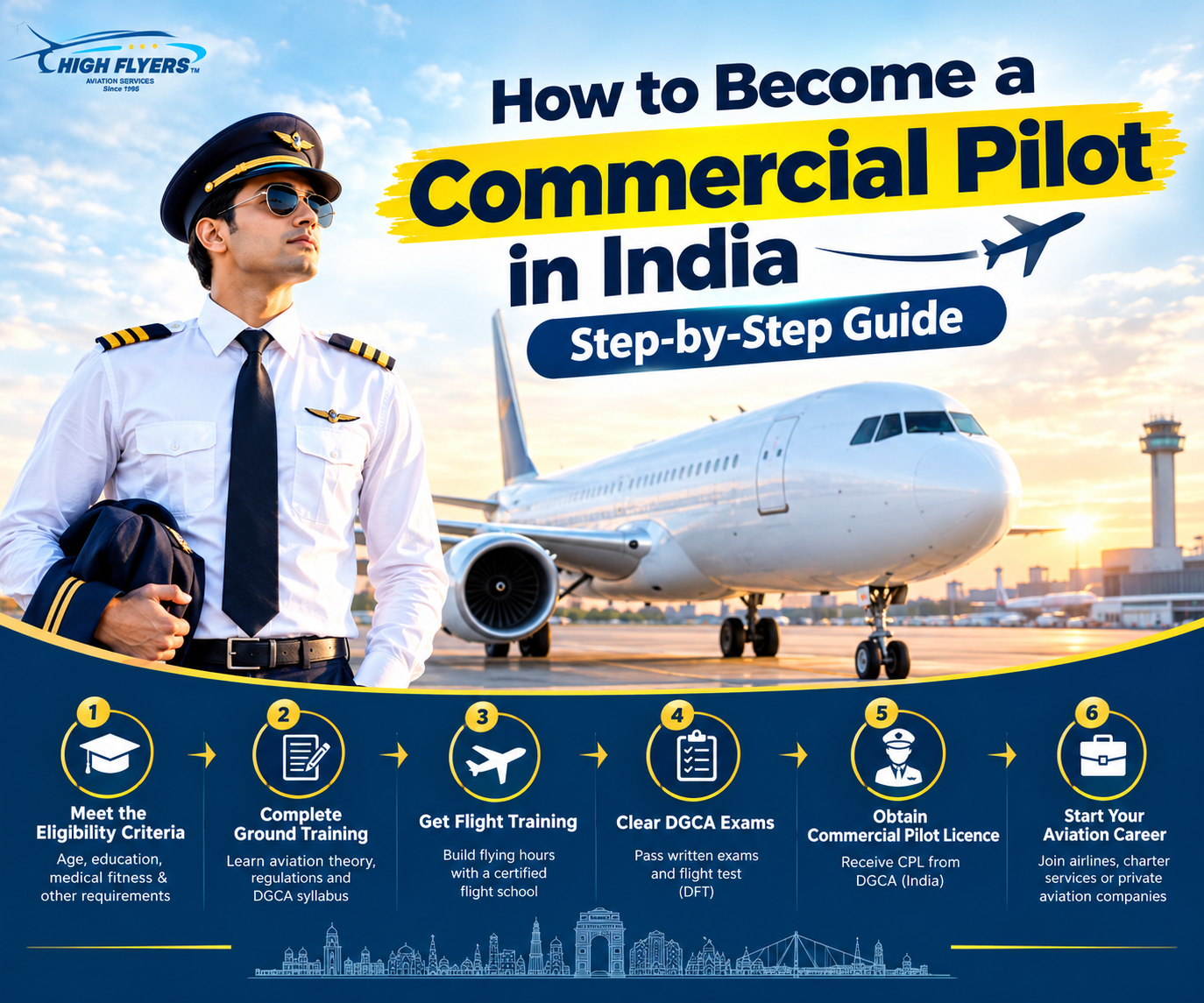
For students who want to be flying aircraft and work in aviation, becoming a commercial pilot is a rewarding career. Knowing how to get a commercial pilot license in India is the first step in turning this dream into reality. This process includes certain educational qualifications, a medical examination, some theoretical knowledge, flying experience, and an examination. At each stage of the process, with the help of professionals, you can prepare yourself better.
Step1: Knowing the Pilot Training Requirements in India
Before starting training, a person should be aware of the how to become a pilot. The DGCA is responsible for the training and examination requirements of a pilot.
An individual should be aware of their educational qualifications, medical eligibility, training requirements and available budget, before enrolling for training. Making such preparations early can save time and help individuals make appropriate choices for their career in aviation.
Step 2: Obtain Your Educational Qualifications
Individuals should complete their Class 12 with Physics and Mathematics or an equivalent qualification recognized by the DGCA. Students should always check the latest DGCA notifications and circulars before flight training and examinations.
Students who do not have Mathematics or Physics in their qualification should explore other accepted means of achieving these two subjects through a recognized education pathway.
It is important for a student to have a basic understanding of Physics and Mathematics to interpret flight information. Proper knowledge of English helps individuals communicate effectively in aviation industry.
Step 2: Meet the Medical Requirements
Being medically fit is an important part of being a pilot. There are medical requirements that one must meet in order to be awarded a pilot’s license.
Aspiring pilots should acquaint themselves with the various aspects of class 2 and class 1 medicals and consult the licensed aviation medical examiners about the procedure. Candidates are suggested to do their medical checkups well in advance as it helps them understand their eligibility to get a pilot’s license, before they make a financial commitment to the course.
Candidates are also advised to follow medical recommendations as aviation medical certification is governed by specific regulatory standards.
Step 3: Select A Pilot Training Institute
Selecting an aviation school is always a big decision. Students wishing to take up pilot training should look for information such as the course structure and curriculum, faculty, training methods, DGCA exams, student support, and other services.
Before enrolling, students are also advised to evaluate the Faculty’s experience and methods of instruction. Look for Support provided for preparation of DGCA exams, adequacy of learning resources, and structure and methods of instruction. Consider availability and pricing of flying training, and sincerity of the Academy in career guidance, as reflected in student testimonials.
Students should check the present recognitions and approvals of the Academy. They should be able to distinguish a ground training institute from a flight training school.
Step 4: Enroll in a Commercial Pilot Training Program
Students planning to enroll for a commercial pilot training institute in india should look for information regarding course fees, course duration, course structure, facilities provided, etc. before taking admission. Students should look for information regarding what a course includes before taking admission.
The training prepares students to become commercial pilots by acquiring aviation knowledge and gaining flying experience. It comprises ground training and flying training. During the ground training, students learn aviation theory which they can implement and practice in flying training.
Students need to review the training course to see what flying experience is required and how it is facilitated by the school.
Step 5: Attend DGCA Ground Classes
DGCA ground classes cover subjects pertinent to the theory syllabus for commercial pilot licensing. The classes cover flying instruments, theory of navigation, rules of the air, and other subjects pertinent to flying.
Ground training covers weather phenomena and how it impact flights. Students learn the different routeing of flights and how routes are planned to ensure compliance to the rules of the air.
In ground classes, students should attend classes regularly, revise what they learn, ask questions on what they do not understand, and prepare for tests.
Step 6: Prepare for and Pass the Required Examinations
It is the responsibility of the students to appear for the DGCA examinations pertaining to their licensing. Students should go through the examination syllabus, and other pertinent details published on the DGCA examination website.
Prior planning and preparation can help students address what they need to know and engage in practical and self directed study of important topics. Consistent study and preparation can help students build confidence for the tests.
Step 7: Complete Practical Flight Training
Practical Flight Training helps a student to learn skills required to operate an aircraft safely. The training involves both ground and flying sessions. The ground sessions include learning various procedures, flight maneuvers and how to plot flights, while the flying sessions involve learning navigation, flight planning and how to respond to various operational situations.
Students must complete the flight training and flying experience as prescribed by the DGCA. The flight training schedules are usually flexible to accommodate the weather, aircraft and instructor availability, students’ progress and the training organization’s plan.
Before choosing a flying school, a student is encouraged to inquire how the flying school manages flight, instructor and aircraft schedules and training records.
Step 8: Complete the Licensing Requirements and Obtain your CPL
Upon fulfillment of the educational, medical, examination and flying requirements, the student can proceed to the relevant licensing process.
The DGCA then assesses the student against the prescribed requirements. It is the student’s responsibility to accurately maintain all records and complete all required assessments before he/she applies for a license.
Reaching this stage is an accomplishment, but it does not mean the student automatically gets employed by an airline. Some airline employers require student’s to undergo further assessment and/or training.
Step 9: Look for Employment Opportunities in the Aviation Industry
Upon the award of the CPL, the pilot is to seek for employment in the aviation industry. Depending on the employment rules of the airline, charter flying, cargo flying and flight training can also be pursued.
Students should expand their technical and general knowledge, improve communication and interpersonal skills, and decision-making skills. Students need to learn more about employer selection processes and consider other qualifications that they may need to possess for their preferred jobs.
The High Flyers assist future pilots by explaining the various options available to them in pursuit of a professional aviation career and helping them plan the next steps in their career.
How long does it take to become a commercial pilot in India?
There are various factors which affect the time taken including the individual student’s rate of academic preparation, weather and winds, and Medical Certification.
Students should be conscious of their budget and schedule and plan to train in a systematic manner.
Tips to Help Select a Pilot Training Path
Before taking training, students should compare best pilot training institute in india. Students should ask for a copy of the agreement and check the costs associated with the training, the training schedule, the school’s refund policy and the regulatory approvals.
For further assistance on writing a will, writing a cover letter, and employment termination information please visit Frequently Asked Questions.
Frequently Asked Questions
1. How can I become a pilot after Class 12 in India?
You need to be 16 years of age to enroll for pilot training. You will be required to clear matriculation. Besides, you should also be medically fit as per the requirements of DGCA. You need to pass training flights and examinations as per the requirements of the DGCA and Flight Training Schools, and organizations to qualify as a Pilot.
2. What is a Commercial Pilot License in India?
A Commercial Pilot Licence is a professional licence which permits the exercise of the privileges contained in the licence, subject to the applicable conditions.
3. How do I choose the best pilot training institute in India?
There are many factors to consider such as faculty, training arrangements, course structure, fees, student support, and regulatory approvals.
4. Is ground training important for commercial pilots?
Yes. Ground training is important for developing the required theoretical knowledge for the pilot to understand the areas of Navigation, Meteorology, Air Law, Operational Procedures, and Principles of Flight and Preparation for Examinations.
Conclusion
Researching your options and planning your training provides clarity for students wanting to pursue a career in this field. The High Flyers also encourages students to be aware of pilot training requirements in India, compare training options, and prepare for each stage. Students make informed decisions and pursue training with a plan to enter the aviation industry.