The first step to pursuing your dream of becoming a commercial pilot is to learn about the DGCA examination system as it plays a major role in aviation career in India. The examinations conducted by the Directorate General of Civil Aviation (DGCA) are mandatory for obtaining the Commercial Pilot License (CPL). The DGCA is the primary authority for pilot licensing and aviation safety in India. Thus, all aspiring commercial pilots will have to clear the DGCA examinations.
The DGCA examinations are meant to evaluate the theoretical knowledge of a candidate in the various subjects of aviation as well as the knowledge required to conduct flight operations in a safe and efficient manner. Due to the competitive nature of these examinations, candidates are required to adopt a well-planned strategy and enroll in good quality preparatory programs in order to improve the likelihood of succeeding in the examination.
It is not a surprise that a good number of aspiring pilots believe in opting for the Best CPL Ground classes in India. Expert guidance, up-to-date study materials, and frequent mock tests boost the preparation and the chances of success. Picking the right preparatory program can improve candidates’ confidence and performance in the examinations.
This complete guide will provide you with useful tips on the DGCA exam syllabus, important subjects, study plans, preparation tips, common mistakes, and why ground classes are important for CPL aspirants.
DGCA Examination System
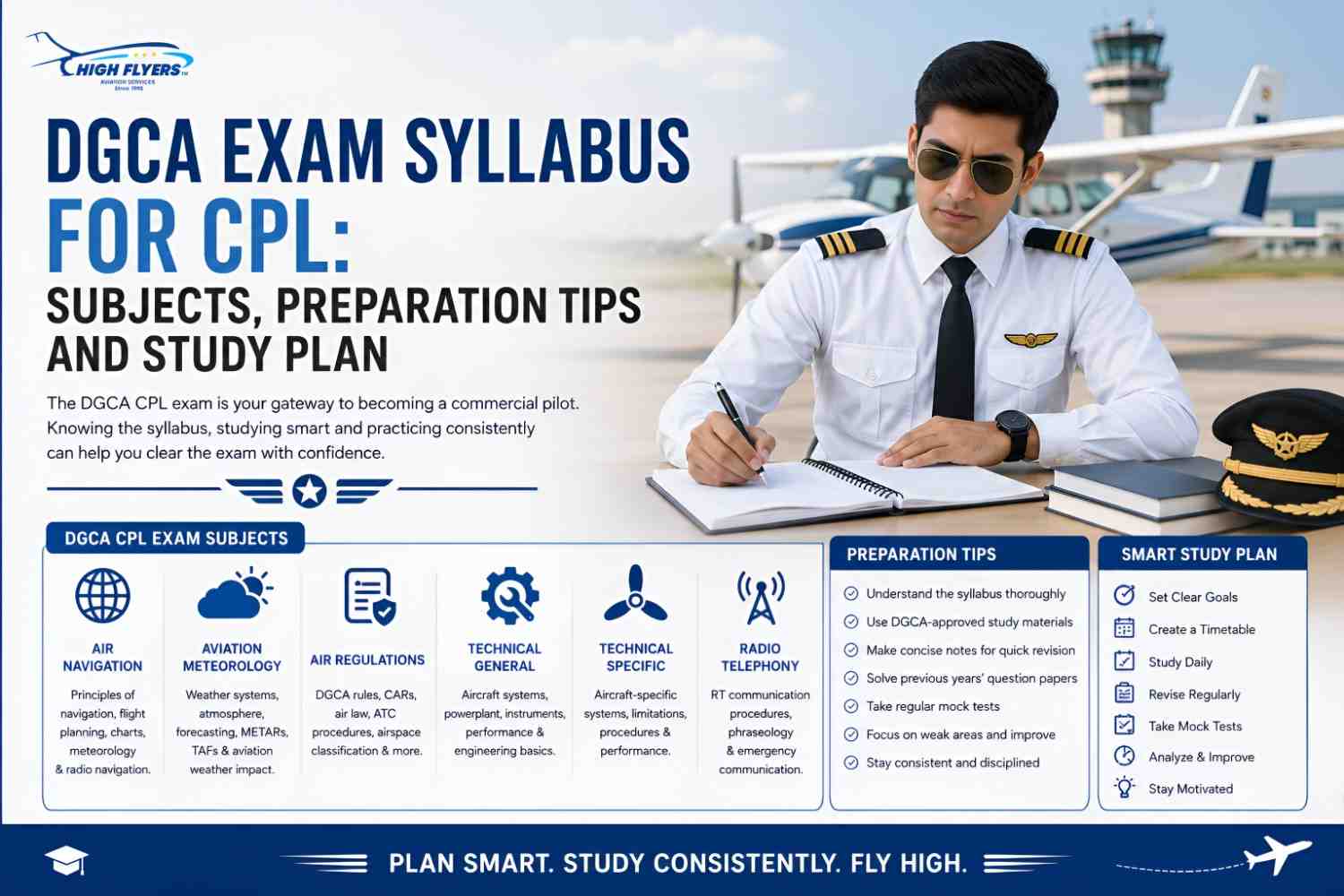
DGCA examinations assess a candidate’s theoretical knowledge of aviation prior to the issuance of Commercial Pilot License, and thus have a wide and comprehensive syllabus of subjects that every professional pilot must know in detail.
Major DGCA subjects for CPL are:
1. Air Navigation
2. Air Regulations
3. Aviation Meteorology
4. Technical General
5. Technical Specific
6. Radio Telephony (RTR)
All of these subjects demand a lot of preparation and revision on the part of the candidates, and have to be understood conceptually.
Air Navigation
Air Navigation is one of the most significant and complex subjects in the DGCA syllabus. This subject not only teaches how to plan routes and identify positions, but also how to navigate aircraft from one point to another safely.
Topics Involved
- Latitude
- Longitude
- Time Calculations
- Maps and Charts
- Flight Planning
- Compass Errors
- Radio Navigation Aids
- Dead Reckoning
- Great Circle and Rhumb Line Navigation
Preparation Tips
- Perform calculations regularly
- Solve previous years’ exam questions
- Learn how to read charts
- Keep the concepts clear
Navigation is one subject in which a student can get a good command of fundamentals. which will also help him/her in commanding while undergoing flying training like Pilot training institute in Delhi and clear the examinations with ease.
Air Regulations
Regulations is one subject which can be scoring, if prepared well and taught. This subject is the study of rules and procedures that govern the operations of aviation in India.
Topics to Cover
- DGCA Rules and Regulations
- Registration of Aircraft
- Licensing Requirements
- Rules of the Air
- Flight Duty Time Limitations
- Safety of Operations
- Standards of Safety in Aviation
- ICAO (International Civil Aviation Organization)
Preparation Strategy
- Study the DGCA manuals
- Prepare short notes
- Keep necessary definitions on hand
- Concisely answer previously asked questions
The knowledge of air regulations enables a pilot to practice aviation safely and give full satisfaction to those who employ him/her.
Aviation Meteorology
Weather is a very important factor in aviation. This subject teaches how the performance of an aircraft may be affected by the conditions of the weather.
Understanding weather patterns helps pilots to make flights safer.
Technical General
Technical General introduces some of the basic ideas about aircraft systems and the science of air.
Key Concepts
- Theory of Flight
- Aircraft Engines
- Fuel Systems
- Hydraulic Systems
- Electrical Systems
- Landing Gear
- Flight Controls
- Aircraft Instruments
Preparation Strategy
- Focus on system flowcharts and how systems interact
- Formulate concise notes
- Do MCQs often for practice
Technically General covers the basic ideas of using and operating aircraft systems.
Technical Specific
This Specific deals with the aircraft used for flight training.
Knowledge Areas
- Aircraft Limitations
- Engine Operations
- Aircraft Systems
- Emergency Procedures
- Performance Charts
- Weight and Balance
This subject is study intensive as it is directly related to the flying you will do.
Radio Telephony (RTR)
This subject deals with the most fundamental skill that a pilot must possess – the ability to communicate.
Topics Covered
- Aviation Phraseology
- Modes of Communication
- Radio Gear
- Emergency Communication
- Control Communications
The ability to communicate clearly and logically is required for the safety of flight.
Preparation for the DGCA CPL Exams
Taking the DGCA Examinations requires one to be disciplined and consistent.
1. Have a proper study plan
A good study plan helps:
- avoid stress and burnout
- cover syllabus efficiently
- manage time properly
2. Get a strong conceptual understanding
DGCA exams focus on application, not memorization.
3. Practice past papers
Helps in:
- understanding question patterns
- improving speed
- building confidence
4. Consistent revision
Revision helps in:
- memory retention
- reducing exam anxiety
- improving accuracy
Beginner Study Plan
1st Month
- Air Regulations
- Basics of Navigation
- Basics of Meteorology
2nd Month
- Technical General
- Navigation Calculations
3rd Month
- Technical Specific
- Advanced Navigation
- Mock tests
4th month
- Full revision
- Practice tests
- Time management
Common Pitfalls
Avoiding Difficult Topics
Do not ignore Navigation. Start early and practice regularly.
Rote Learning
DGCA focuses on concepts, not memorization.
Lack of Practice
Practice is essential for success.
Poor Study Planning
Always follow a structured schedule.
Significance of Ground Classes
Ground classes are crucial for CPL preparation.
Professional training institutes provide:
- Experienced instructors
- Current DGCA syllabus
- Mock tests
- Doubt-clearing sessions
- Study materials
- Personal guidance
Best CPL Ground classes in India are highly sought after as organized training helps clear DGCA exams.
How to Select Training Institutes?
- Experienced trainers
- High success rate
- Updated study material
- Regular mock tests
- Good classroom environment
Best pilot training institute in india is searched widely because quality training leads to aviation success.
A reputed Pilot training institute in Delhi is preferred for strong academic environment and expert faculty.
Career Scope After DGCA Exams
After completing CPL training, career options include:
- Airline Pilot
- Cargo Pilot
- Charter Pilot
- Corporate Pilot
- Flight Instructor
- Air Ambulance Pilot
The aviation industry offers growing opportunities for skilled pilots.
The DGCA CPL examination is a crucial step in a pilot’s journey. With structured preparation, disciplined study habits, and strong conceptual clarity, students can significantly improve their chances of success. Proper training, consistent practice, and expert guidance are key factors that shape a successful aviation career.
FAQ
FAQ 1. What is the structure of the DGCA CPL exam?
It includes Air Navigation, Air Regulations, Meteorology, Technical General, Technical Specific, and RTR.
FAQ 2. How much time is needed for DGCA preparation?
Most students take 4 to 8 months.
FAQ 3. Are DGCA Ground Classes important?
Yes, they provide structured learning, mock tests, and expert guidance.
FAQ 4. How to prepare effectively for DGCA exams?
Follow a study plan, revise regularly, solve past papers, and focus on concepts.