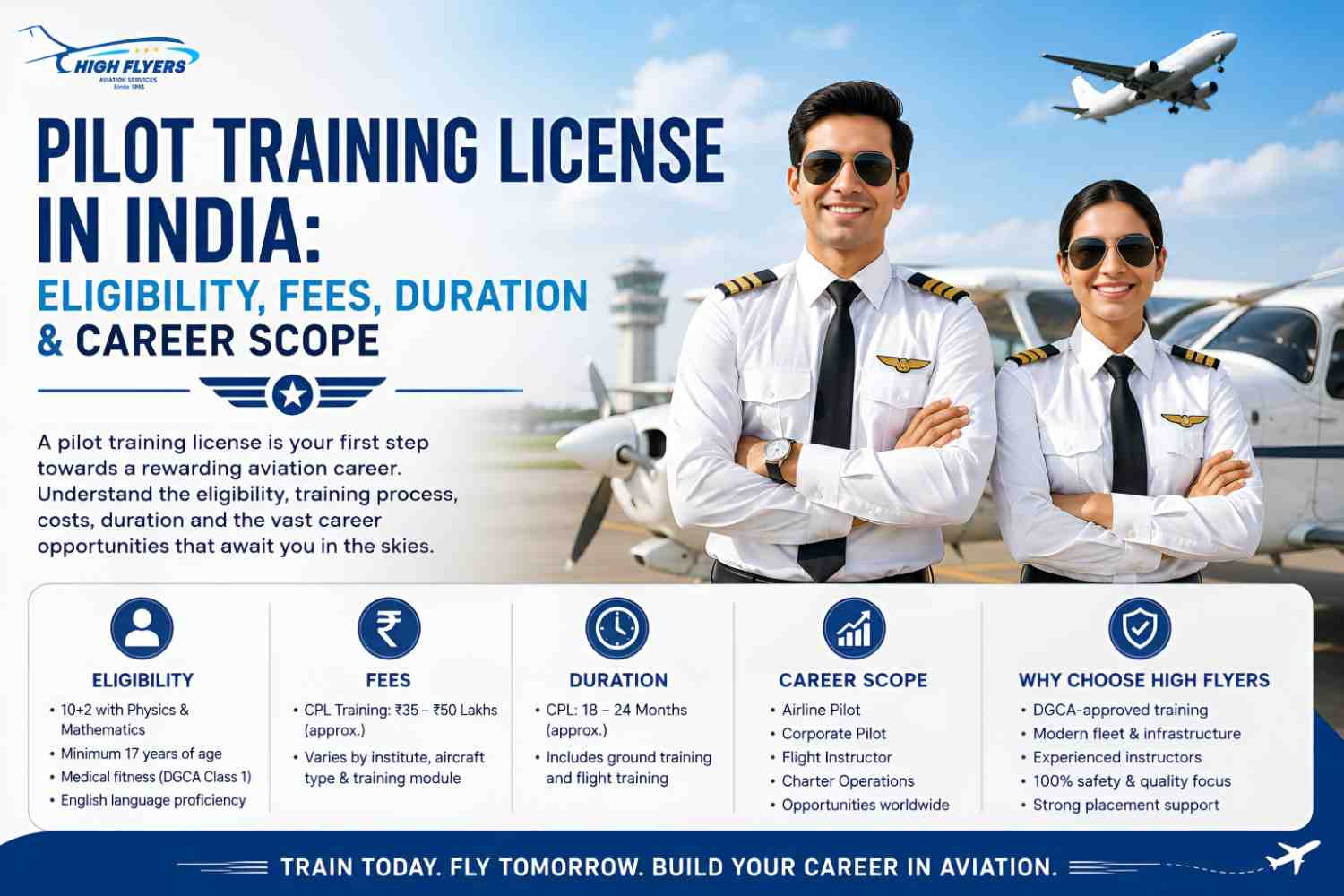
Rapid development in India’s aviation sector means bright prospects for new pilots. Having a Commercial Pilot License (CPL) is essential for those who wish to fly as a profession. A CPL is the first major milestone for those who wish to enter various streams of aviation, be it passenger carrying, freight flying, or charter operations, and even for those who wish to fly for overseas airlines.
A Commercial Pilot License (CPL) enables one to operate aircraft for gainful flying services. With more airlines operating, increased regional connectivity and a strong increase of passenger travel in India, the need for more trained commercial pilots is unprecedented.
This has led to an increased number of students considering a range of training options and identifying the Commercial Pilot License in Delhi to pursue their dream of flying.
However, it’s imperative to know a range of factors before enrolling in any pilot training programs such as eligibility criteria, DGCA norms, duration of the training, fees, and career prospects. This article aims to help those interested in the path for obtaining a best pilot training colleges in Delhi.
What is a Commercial Pilot License (CPL)?
A Commercial Pilot License certifies an individual to fly an aircraft for commercial flying and is issued by the Directorate General of Civil Aviation (DGCA). It is an essential requirement for those who wish to pursue a career in professional flying.
A holder of a Commercial Pilot License (CPL) can work in multiple divisions of aviation such as:
- Commercial Airlines
- Cargo Services
- Charter Aviation
- Air Ambulance Services
- Corporate Aviation
- Flight Training Organizations
The Aviation sector is becoming a popular choice of profession for the youth of today due to the benefits of a lucrative salary, potential for growth, and opportunities to work across the globe.
CPL Eligibility Criteria in India
Before beginning your journey to becoming a pilot, it is important to be knowledgeable about CPL eligibility criteria. There are a few provisions laid down by the Director General of Civil Aviation (DGCA) that must be fulfilled.
Educational Qualification
The aspiring CPL candidate must have:
Completed the 10+2 level of education, with a combination of Physics and Mathematics.
If you are from another stream, you can opt for Open Schooling approved by the National Board of Examinations to learn Physics and Mathematics.
A better academic background enables students to grasp concepts of aviation with ease during the ground class.
Age Requirement
The aspiring candidate for the Commercial Pilot License must be at least:
18 years for issue of CPL.
Students can begin aviation training at a younger age and complete the other requirements as well, and receive the license later.
Medical Fitness
For a career as a pilot, medical fitness is a primary requirement.
The aspiring candidate must:
Clear the DGCA Class II Medical Examination.
Clear DGCA Class I Medical Examination, prior to issue of CPL.
Good eyesight, physical fitness and health are essential as well for a career as a Pilot.
DGCA and Commercial Pilot License
In India, the pilot training and licensing is controlled by the Directorate General of Civil Aviation. The students will have to comply with all the provisions of DGCA to acquire the Commercial Pilot License.
DGCA Ground Subjects
The following subjects make up a portion of the DGCA examinations which students must clear:
- Air Navigation
- Air Regulations
- Aviation Meteorology
- Technical General
- Technical Specific
- Radio Telephony (RTR)
Due to the importance of these subjects, many aspiring pilots take DGCA Ground Classes in New Delhi.
The offering of ground classes includes:
- Expert faculty guidance
- Regular mock tests
- Study material that is up to date
- Preparation strategies that are exam oriented
One need to have both theoretical knowledge and flying skills to become a successful commercial pilot.
CPL Course Duration in India
Students often ask the same question; How long does it take to become a commercial pilot?
The time frame is between 18 and 24 months. This duration is influenced by:
- Weather conditions
- Flying schedules
- Availability of aircraft
- DGCA exam schedules
- Student performance
Those students who finish their ground and air training first are the ones who are able to become commercial pilots in the stipulated time frame.
CPL Training Process Step by Step
This process includes several steps.
Step 1 Finishing All Educational Requirements
This means that one must have passed the 10+2 level of schooling and must have taken Physics and Mathematics.
Step 2 Medical Fitness
DGCA conducts certain medical tests to clear candidates for flying.
Step 3 Ground Training
This is the stage where the candidates are required to join a recognized aviation Academy and prepare for DGCA ground subjects.
Step 4 Flying Training
This is the stage where the candidates get a practical exposure to flying by taking lessons from a flying instructor.
Step 5 DGCA Exams
This is the stage where the candidates are required to clear all the ground subjects of DGCA and the flying exam.
Step 6 Complete Flying Hours
You need to accumulate the flying hours required by the DGCA.
Step 7 Apply for CPL
Complete the requirements and apply for the Commercial Pilot License.
Flying Hours for CPL
Flying hours are one of the most crucial aspects of pilot training.
DGCA mandates the following:
A minimum of 200 hours of flying.
Hours include:
- Solo flying
- Cross-country flying
- Instrument flying
- Night flying
- Dual flying
Training exposes the candidate to flying in diverse situations as well as developing the skills for making decisions.
CPL Fees in India
The cost of getting a Commercial Pilot License depends on many factors like the flying school, the flying school, the aircraft, fuel costs, and facility costs.
The complete CPL training cost comprises:
- Flying training charges
- Ground training fees
- DGCA examination fees
- Medical examination fees
- Study materials
- Simulator training
- License processing fees
It is recommended that students check the quality of training, the infrastructure, and the placement support before making the decision of the training institute.
Career Opportunity After CPL
A Commercial Pilot License can offer you a wide array of opportunities.
Popular avenues of employment include:
Airline Pilot: A CPL holder can become an airline pilot after some additional training and a type rating.
Charter Pilot: A CPL holder can operate a private aircraft for business or VIP charter clients.
Cargo Pilot: A CPL holder can operate as a pilot for the transport of cargo.
Corporate Pilot: A CPL holder can operate a business aircraft for a corporation.
Flight Instructor: An experienced CPL holder can become an instructor.
The aviation industry is continuously expanding and offers great opportunities and potential growth.
How Choosing the Right Flying School?
Beginning a flying career means making lots of decisions, the most important of which is choosing the school.
Most students looking for training options across India prefer the Best Pilot training institute in Delhi. This can be attributed to the instructors’ expertise in the aviation industry, the quality of ground classes, advanced training, and the best facilities available.
Students should also consider:
- DGCA approval
- Quality of instructors
- Modern fleet
- Quality of training
- Assistance in placement
- Infrastructure
- Success rate
In addition to the institutes in Delhi, aspiring pilots look at the options to obtain a Commercial Pilot License in Delhi due to the large number of quality institutes in aviation education and supportive academics.
A Commercial Pilot License lays the groundwork for a successful career in aviation. With planning, good training, and hard work, it is possible to realize this dream and build a successful career in aviation. By researching the eligibility criteria, DGCA requirements, flying hours, fees, and career prospects, students can evaluate options and make informed decisions on their training.
The right choice in aviation academy, quality guidance in theory, and instruction in practical flying will enable aspiring pilots to realize their dream of flying.
FAQ
FAQ 1. What is the minimum qualification to apply for a CPL in India?
The candidate should have completed 10+2 with a board of education and should have studied Physics and Mathematics.
FAQ 2. What is the duration of the CPL course in India?
The CPL course in India is approximately 18 to 24 months, pending flying hours, weather, and DGCA exams.
FAQ 3: What is the minimum number of flying hours to get a Commercial Pilot License in India?
To get a CPL in India, students must complete a minimum of 200 flying hours.
FAQ 4: What careers can you pursue after earning a CPL?
After earning your CPL, you can become an Airline Pilot, Charter Pilot, Cargo Pilot, Corporate Pilot, or Flight Instructor.