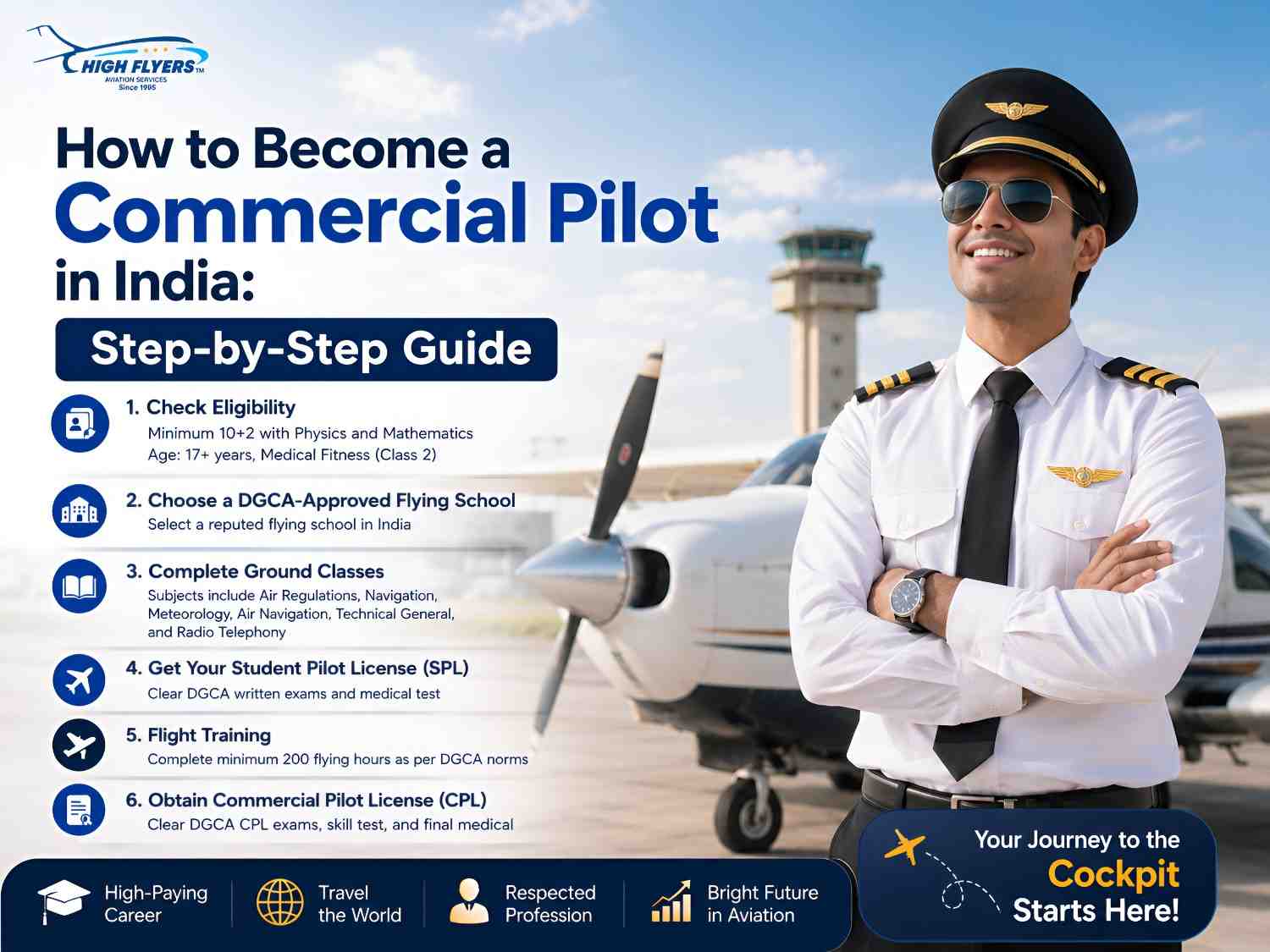
Becoming a commercial pilot is an incredible opportunity for students with a passion for flying, and for good reason given the exciting and fulfilling nature of the career. With the growth of India’s aviation industry happening as we speak, the industry is in need of more skilled pilots. Potential pilots need to keep in mind the investment and planning this career needs as well as the choice of a knowledgeable professional to help along the way. This is where the decision of CPL Ground classes in India will come into play. Quality theoretical knowledge aids the foundation of successful flight training, and is greatly supported by excellent ground school.
The High Flyers provides aspiring pilots with guidance in the preparation of DGCA along with the development of skills and knowledge for the success in their aviation career. Whether you are looking for DGCA Pilot Training in Jaipur, the Best Pilot training institute in Delhi, or a trustworthy Pilot training institute in Delhi, knowing the complete picture will help you choose wisely.
Why Become a Commercial Pilot?
As a commercial pilot, you will fly both domestic and international flights, and will have the responsibility of the safety and comfort of your passengers and a crew. You will also enjoy several opportunities to grow your career, realize a great income, and work with the world’s best airlines.
Other advantages of becoming a commercial pilot are:
- Earn a great income
- Get a job that affords you the opportunity to travel around the world
- Join a career that is exciting and that will continue to develop and grow
- General world wide respect
As the Indian aviation industry grows, there is also an increase in the demand for skilled pilots meaning there is no better time to pursue this career.
Step 1: Know What a Commercial Pilot Does
Before you invest time and money into pilot training, be sure you know what being a pilot means.
Some job duties of a commercial pilot are:
- Transporting people and goods
- Doing inspections before flights
- Deciding what routes to take
- Keeping an eye on the weather
- Talking to ATC
- Dealing with emergencies
- Keeping a log of flights
Pilots need to know a lot of technical information, be good at making decisions, and be able to manage stress.
Step 2: Know What the Requirements Are
Before someone can become a pilot, they need to meet a few requirements set by the DGCA.
Education
They need to finish 10+2 and take Physics and Maths or the equivalent.
If you did not take those subjects in high school, you can take them through an open schooling program.
Age
You need to be at least 18 years old.
Health
Getting a medical certification is important as you need to be in good health to be a pilot.
You need a DGCA Class II Medical certificate and then a Class I to get your license.
The exams check a lot of different health factors, including your vision and hearing.
Step 3: Pick the Right Ground School
Some people think they just need to focus on getting their flight hours, but ground school is just as important.
Classes at ground school prepare you for the DGCA exams on the important subjects of aviation.
Selecting the Best CPL Ground classes in India gives students a head start and boosts their preparation and understanding of the basic concepts in aviation before they commence their flight training.
At The High Flyers, our students get structured classroom training, expert mentorship, doubt-clearing sessions, and focused, exam-oriented coaching for success in the DGCA examinations.
Step 4: Clear DGCA Ground Subjects
The DGCA Ground Subjects have a prerequisite for the award of a Commercial Pilot License. The DGCA Ground Subjects include:
Air Navigation
While learning this subject, students learn flight planning concepts and the Navigation systems and calculations of Latitude and longitude, and Time, while also learning to interpret Maps and Charts.
Aviation Meteorology
While learning this subject, students learn about Weather systems and Weather forecasting, and learn about Winds, Clouds, Rainfall, and Turbulence.
Air Regulations
While learning this subject, students learn about the Laws of Aviation, Regulations pertaining to Air Traffic, and the Rules of Flight, and learn about the Licensing Regulations and International Standards of Aviation.
Technical General
While learning this subject, students learn about the various systems of an Aircraft, and also learn about Engines, and Electrical and Hydraulic Systems, and the performance of Aircraft.
Learning these subjects enhances your chances with the DGCA examinations on your first attempt.
Step 5: Select a Reputed Flying School
Selecting the right flying school is a major decision in your aviation career. A few things you must consider are: DGCA approval, experienced teachers, a modern fleet of aircrafts, flight simulators, safety, success of students, infrastructure, and support for placement.
Students looking for the Best Pilot training institute in Delhi must compare the quality of courses, and the training, and the experienced faculty over costs, while aspiring aviators looking for a professional Pilot training institute in Delhi must look for an institute that has Ground class and flight training support.
Step 6: Begin Flight Training
When the theoretical work concludes, practical flight training begins.
This part of the training encompasses:
- Familiarization Flights
- Flight Controls
- Taxiing
- Takeoff
- Landing
- Radio work
- Emergency Procedures
- Navigation
- Flight Training
- Solo Flight
Experience of flight training enhances confidence and sharpens the ability to make decisions.
Step 7: Accumulate the Flight Training Hours
The next step towards obtaining a Commercial Pilot License is to accrue the hours of flight training stipulated by the DGCA.
The flight training hours consist of:
- Dual Flight
- Solo Flight
- Cross-Country Flight
- Instrument Flight
- Night Flight
It is imperative that flight logs are kept accurately during the training.
Step 8: Learn to Communicate Like a Pilot
As a professional Pilot, you will be in constant communication with Air Traffic Control.
Your training will cover:
- Standard Aviation Phraseology
- Radio Work
- Emergency Communications
- Airport Procedures
- International Communication Standards
Communication is the key to safety in the air.
Step 9: Learn the Skills of a Pilot
Successful Commercial Pilots possess a wide variety of skills, beyond the knowledge of how to operate an aircraft.
These skills include:
Decision Making
A Pilot must be able to make sound decisions in the face of rapidly changing weather and emergency situations.
Situational Awareness
Accidents and incidents can be avoided by knowing your Aircraft’s position, the weather, traffic, and activities at the Airport.
Leadership
The safety of all on board is the responsibility of the Captain, who is the leader of the Flight Crew.
Teamwork
Pilots work with the Cabin Crew, Air Traffic Control, the Engineer, Ground Staff, the Operations Team, and other personnel.
Good teamwork is essential for a successful flight.
Step 10: Keep Fit
Aviation requires excellent physical and mental fitness.
Pilots should lead a healthy lifestyle by:
- Staying fit by exercising
- Eating healthy
- Getting sufficient sleep
- Keeping stress at a manageable level
- Remaining Medical Fit
The above will improve your focus and performance when flying.
Step 11: Obtain Your Commercial Pilot License (CPL)
Once you have completed the DGCA ground examinations and fulfilled the requirements for flying hours, medical certifications, and skill tests, the next step is to obtain the Commercial Pilot License (CPL) from the Directorate General of Civil Aviation (DGCA).
To obtain a CPL, a candidate must generally:
- Undertake all DGCA theory examinations.
- Complete the necessary flying hours.
- Hold a Class I Medical Certificate.
- Pass the RTR (Radio Telephony Restricted) examination.
- Pass the DGCA skill test.
You can apply for a Commercial Pilot License and commence your flying career after fulfilling the above requirements.
Step 12: Type Rating Training
Most airlines prefer pilots to complete Type Rating after obtaining a CPL. Type Rating is the training that qualifies pilots to operate a particular model of an aircraft such as:
- Airbus A320
- Boeing 737
- ATR 72
- Embraer aircraft
This training comprises:
- Aircraft systems.
- Simulated training.
- Emergency procedures training.
- Line oriented flight training.
- Aircraft manipulation training.
This certification qualifies a pilot to operate a commercial passenger aircraft.
Step 13: Apply for Airline Jobs
You can apply for airline jobs after obtaining a CPL and completing Type Rating.
Some of the options are:
- Domestic Airline Services
- International Airline Services
- Cargo Airline Services
- Charter Aviation Services
- Corporate Aviation Services
- Government Aviation Services
- Flying Instruction
- Air Ambulance Services
The Indian Aviation Industry is growing and offers a number of opportunities for qualified commercial pilots.
Common Challenges Faced by Student Pilots
Pursuing a commercial pilot license is not easy. Challenges are faced along the way by all pilots in training.
Here are some of the challenges prospective pilots face:
- Passing the DGCA exams
- Financing and participating in flight training
- Logging flying hours
- Grasping technical subjects
- Dealing with delays due to weather
- Gaining confidence to complete solo flights
Challenges like these are all easier to deal with when you have the right mindset and are working with seasoned professionals like the team at The High Flyers.
Importance of Professional Ground Training
Theoretical training is essential, and yet is often undervalued by students.
Investing in Professional Ground Training is the best way to:
- Gain a solid understanding of aviation theory
- Establish a sound aviation footing
- Prepare for the DGCA exams
- Perform better in practical flying
- Enhance confidence and reduce stress
Most of the students pursuing DGCA Pilot Training in Jaipur first attend quality ground training and then enhance their flying skills by attending advanced flying classes to ensure they are well prepared to take on the next phase of their aviation career.
What Airlines Look for When Hiring a Commercial Pilot?
Flying skills are essential, but there are other attributes to being a pilot.
A few of these are:
Leadership
Pilots are in charge of the rest of the flight crew and are required to make sound judgements.
Communication
Pilots are required to communicate with Air Traffic Control, the flight crew and the passengers.
Calmness and Discipline
Pilots are required to remain calm to address issues that may arise and are required to maintain discipline by abiding to the procedures and protocols for flying.
Sound Judgement
Pilots are required to make the right call at the right time to ensure safety of the passengers.
FAQ
1. What qualifications are required to become a commercial pilot in India?
Candidates must complete 10+2 with Physics and Mathematics, meet DGCA medical standards, pass DGCA examinations, and complete the required flying hours.
2. How long does it take to become a commercial pilot?
Depending on the training schedule and flying availability, most students complete their CPL training within 18–24 months.
3. Why are CPL ground classes important?
Ground classes prepare students for DGCA examinations by covering subjects such as Air Navigation, Meteorology, Air Regulations, and Technical General.
4. How do I choose the right pilot training institute?
Select an institute with experienced instructors, quality training, strong student support, and a proven record of preparing successful commercial pilots.